Solar Panel Systems vs Traditional Electricity: Cost, Reliability & Long-Term Benefits
Every Sri Lankan household and business faces the same unavoidable reality: electricity is expensive, the grid is unreliable, and both problems are getting worse. As CEB tariffs continue rising and power cuts remain a fact of life in many areas, more people are asking a straightforward question — is a solar panel system actually worth it compared to staying on the traditional grid?
This guide breaks down the honest comparison: upfront costs, ongoing reliability, long-term financial benefits, and what the data from real installations tells us.
The Core Problem with Traditional Grid Electricity in Sri Lanka
Sri Lanka’s national grid has served the country for decades, but it comes with compounding disadvantages for today’s consumer.
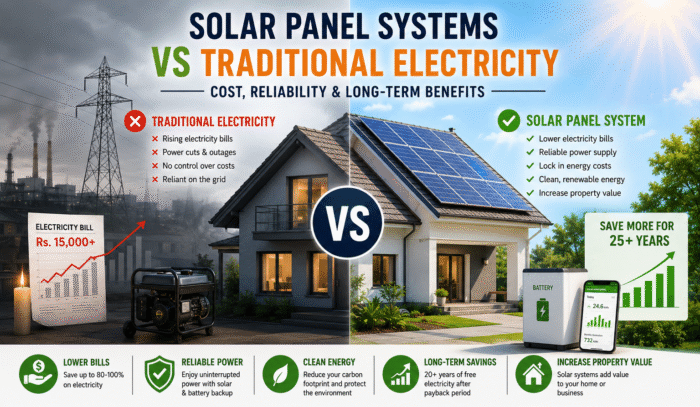
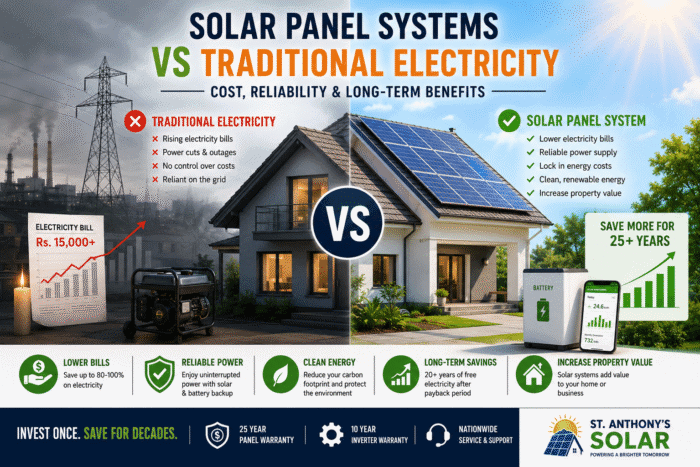
Rising tariffs with no ceiling. The Ceylon Electricity Board has revised electricity tariffs multiple times in recent years. The tiered pricing structure means that the more electricity you consume, the disproportionately higher you pay per unit. A household consuming 500 units per month can pay three to four times more per unit than one consuming 100 units — simply because of which pricing tier they fall into.
Grid instability and outages. Load shedding, transformer failures, and weather-related disruptions interrupt power supply regularly across many parts of the country. For businesses, every hour of downtime has a direct cost. For households, it means food spoilage, disrupted routines, and reliance on expensive backup generators.
No control over future costs. When you rely entirely on the grid, your electricity expense is determined by government policy, fuel prices, and infrastructure decisions — none of which you can influence. Your bill this year may be 30–40% higher than it was three years ago, and there is no mechanism to lock in your current rate.
Solar Panel Systems: A Direct Alternative
A solar panel system gives you the ability to generate your own electricity from sunlight — a resource that is free, abundant, and consistent in Sri Lanka. The comparison with traditional electricity is not simply about cost; it covers energy independence, reliability, and long-term wealth creation.
Here is how the two compare across the factors that matter most.
Cost Comparison: Solar vs Grid Electricity
Upfront Investment
Traditional grid electricity requires no upfront payment — you simply pay monthly. This appears to be an advantage, but it means you are permanently locked into paying for electricity at whatever rate the CEB sets, for the rest of your life.
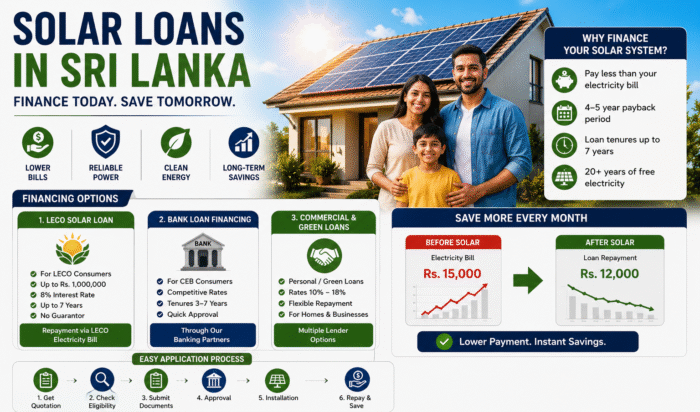
A solar panel system requires an upfront capital investment. A residential on-grid system in Sri Lanka typically ranges from around Rs. 1.5 million for a 5 kW system to Rs. 3 million or more for a larger 10 kW system, depending on panel quality, inverter brand, and installation complexity. A hybrid system with battery storage will cost more due to the added battery component.
The Payback Calculation
The payback period for a well-designed solar system in Sri Lanka averages 4–5 years. After that point, the electricity your panels generate costs you nothing. Given that quality solar panels carry 25-year performance warranties and inverters typically last 10–15 years, a homeowner who installs solar today can realistically expect 20 or more years of largely free electricity after the initial payback period.
Compare that to the grid: a household spending Rs. 15,000 per month on electricity spends Rs. 180,000 per year, and Rs. 3.6 million over 20 years — at today’s rates. If tariffs continue rising, that figure is considerably higher.
Ongoing Running Costs
Grid electricity: ongoing monthly bills with no ceiling and no fixed rate.
Solar panel system: near-zero ongoing costs. Panels require periodic cleaning, inverters need occasional servicing, and monitoring should be checked regularly — but none of these carry significant expense compared to monthly bill elimination.
Reliability Comparison: Solar vs Grid
Grid Dependence
Traditional electricity connects you entirely to the CEB infrastructure. A fault anywhere in the chain — the national grid, a regional substation, or a local transformer — cuts your supply. You have no fallback.
On-Grid Solar
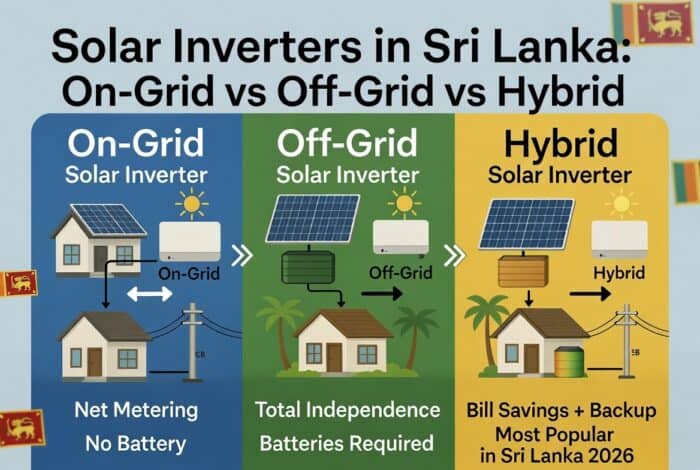
An on-grid solar panel system is connected to the grid and generates electricity during daylight hours, reducing your dependence significantly. However, for safety reasons, on-grid inverters are designed to shut down during a grid failure — meaning power cuts still affect you during the day if you don’t have battery storage.
Hybrid Solar with Battery Backup
A hybrid system adds a battery bank that stores surplus solar generation during the day. When the grid goes down, the battery seamlessly takes over and powers your home or business without interruption. For areas with frequent load shedding, or for businesses where downtime is costly, a hybrid system provides a level of reliability that the traditional grid simply cannot offer.
St. Anthony’s Solar’s hybrid systems use lithium iron phosphate batteries — including BYD HVS and GSL battery ranges — which support over 8,500 charge cycles and carry 10-year warranties, making them a long-life and low-maintenance reliability solution.
Long-Term Benefits: What the 25-Year Picture Looks Like
Financial Asset Creation
A solar panel system is not just an energy solution — it is a financial asset installed on your property. Unlike paying monthly electricity bills (money that leaves your hands permanently), the capital invested in a solar system stays tied to your property and continues generating value year after year.
For homeowners, a solar installation can increase property attractiveness and perceived value. For businesses, it converts a fixed overhead expense into a capital investment with measurable ROI.
Earning from Excess Generation
Under Sri Lanka’s CEB schemes, households and businesses generating more electricity than they consume can earn from that surplus. Under the net accounting scheme, excess units are purchased by the CEB at LKR 37 per unit. Under net plus, industrial consumers earn LKR 37 per unit on all electricity generated, turning a large roof area into a passive income stream.
This is fundamentally different from the grid relationship, where money flows in one direction only — out of your pocket.
Hedge Against Future Tariff Increases
Every kilowatt-hour your solar panels generate is one you do not have to buy from the grid at whatever rate the CEB charges in 2028, 2030, or 2035. As tariffs rise — and historically they always do — the financial value of your self-generated electricity increases proportionally, without any additional cost to you.
Environmental Contribution
Beyond personal finances, solar generation directly reduces your dependence on grid electricity, which in Sri Lanka is still partially generated from thermal and fuel-based sources. Choosing a solar panel system contributes to the island’s clean energy transition — a benefit that extends well beyond your household or business.
How a Solar Panel System Works: Step-by-Step
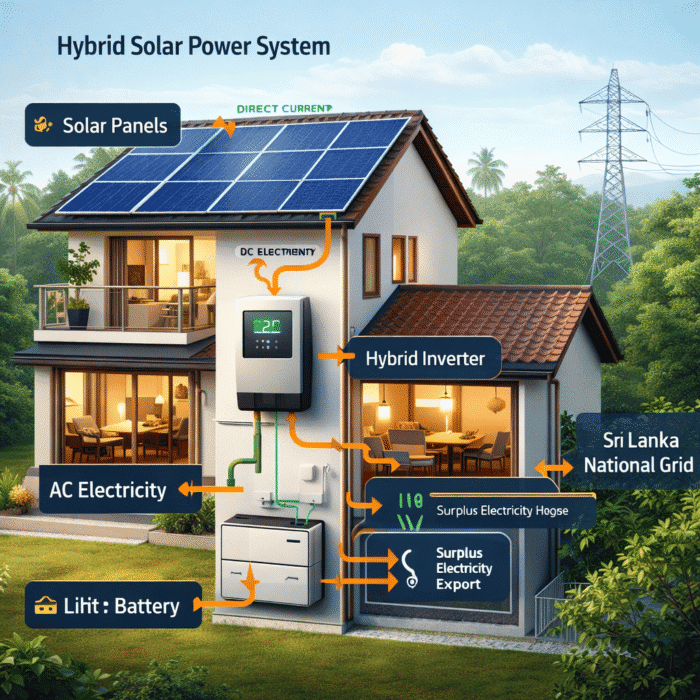
- Sunlight reaches your panels. During daylight hours, solar radiation hits the monocrystalline or polycrystalline cells in your panels, generating direct current (DC) electricity.
- The inverter converts the current. DC electricity flows from the panels to the inverter, which converts it to alternating current (AC) — the standard used by all household appliances and the national grid.
- Your home is powered first. AC electricity flows directly to your electrical distribution board, powering your lights, appliances, and equipment in real time — at zero cost per unit.
- Surplus goes to the grid (or battery). In an on-grid system, any electricity you generate beyond what you’re using at that moment flows through your smart meter to the CEB grid, earning you credits. In a hybrid system, surplus charges your battery bank first; once full, it flows to the grid.
- At night or during low generation. You draw from the grid as normal (on-grid system) or from your battery (hybrid system). Your CEB bill reflects the credits already earned during the day.
- You monitor everything remotely. Modern inverters connect to your home Wi-Fi and feed real-time data to a monitoring app on your phone or computer. You can track daily generation, monthly totals, and system performance at any time.
- Your bill shrinks — or disappears. At the end of each billing cycle, your meter reading reflects the net difference between what you consumed from the grid and what you generated and fed back. In a correctly sized system, this figure approaches zero.
How to Switch from Traditional Electricity to Solar: A Practical Guide
Step 1 — Review your electricity bills. Collect your last 6 months of CEB bills and calculate your average monthly unit consumption. This determines the correct system size for your situation.
Step 2 — Assess your roof. Identify usable, south-facing roof area that receives unobstructed sunlight. A 5 kW system needs approximately 25 square metres; an 8.5 kW system needs around 43 square metres.
Step 3 — Decide on system type. Choose between an on-grid system (lower cost, grid-tied) or a hybrid system (battery backup, greater independence). Your decision should factor in your local grid reliability and whether uninterrupted power is critical to your household or business.
Step 4 — Request a professional assessment. A qualified solar company will conduct a site survey, assess shading, roof structure, and orientation, and recommend the optimal system configuration and capacity.
Step 5 — Evaluate the proposal carefully. Compare panel efficiency ratings, inverter brands, warranty terms, and after-sales service commitments — not just the headline price. A cheaper system with lower-quality components will underperform and cost more over time.
Step 6 — Submit CEB application. Your installer handles the net metering or net accounting application to the CEB, along with the required technical documentation and meter upgrade request.
Step 7 — Installation. A professional residential installation typically takes 1–3 days. The system is then commissioned, tested, and connected to the monitoring platform.
Step 8 — Monitor, compare, and save. From your first full billing cycle, compare your CEB bill against the previous period. Most customers see an immediate and dramatic reduction — or elimination — of their electricity expense.
Frequently Asked Questions: Solar Panel Systems vs Grid Electricity
Is a solar panel system cheaper than grid electricity in Sri Lanka? Over a 10–25 year horizon, yes — significantly. The upfront cost is higher, but once the system pays itself back (typically within 4–5 years), the electricity it generates is essentially free. Grid electricity, by contrast, is a permanent and increasing expense with no payback.
What happens to my electricity supply at night with solar? An on-grid system draws from the CEB grid at night, as normal. However, the credits earned during the day offset what you consume at night, keeping your net bill low. A hybrid system uses stored battery power at night, reducing grid draw further.
Can a solar system handle my air conditioner and water heater? Yes, provided the system is sized correctly. High-consumption appliances like air conditioners and water heaters are best run during peak solar hours (roughly 9am–3pm) to maximise direct solar usage and minimise grid draw.
Does the system work during cloudy or rainy weather? Solar panels generate electricity under diffused light conditions — not just direct sunlight. Output is reduced on heavy overcast days but not eliminated. Sri Lanka’s climate provides sufficient annual irradiation for strong year-round performance even accounting for monsoon seasons.
What if I generate more electricity than I need? Surplus electricity earns you value. Under net metering, it rolls forward as a credit on your next bill. Under net accounting, the CEB pays you LKR 37 per unit. Either way, you benefit financially rather than losing that generation.
How long do solar panels last? Quality panels carry 25-year linear performance warranties, guaranteeing output at a specified percentage of rated capacity for that duration. Most panels continue generating electricity well beyond 25 years, just at a gradually reduced efficiency. The inverter typically requires replacement once during the panel’s life.
Is solar a viable option for businesses and not just homes? Absolutely. Businesses with significant daytime electricity consumption — retail, hospitality, manufacturing, offices — are often the best candidates for solar, since their peak consumption aligns precisely with peak solar generation. The financial savings are proportionally larger, and the ROI case is compelling.
How do I know what system size I need? Your average monthly unit consumption, divided by the average daily generation per kW of solar in Sri Lanka (approximately 3.8–4.2 kWh per kW per day), gives you a baseline system size. A professional installer will refine this based on your specific roof and consumption profile.
Most Searched Comparisons: Solar Panel System vs Grid in Sri Lanka
Solar panel system cost vs electricity bill savings Sri Lanka: A system costing Rs. 2–3 million today can save Rs. 150,000–200,000+ per year in electricity costs, recovering the investment in 4–5 years and generating positive returns for 20+ years thereafter.
On-grid vs hybrid solar system Sri Lanka: On-grid is lower cost and suited to stable grid areas; hybrid adds battery backup for power cut resilience. The right choice depends on your local grid reliability and how critical uninterrupted power is to you.
CEB net metering vs net accounting: Net metering suits high-bill households with limited roof space — it zeros the bill. Net accounting suits those with more roof space than their consumption requires — it generates income from excess generation.
Solar panel efficiency comparison Sri Lanka: Premium panels such as JA Solar’s 550W monocrystalline modules operate at 20.9% efficiency, compared to the market average of around 16.4%. Higher efficiency means more generation from less roof space — a key factor when roof area is limited.
Best solar company Sri Lanka: Look for demonstrated installation experience, quality equipment from reputable brands, clear warranty terms (25 years on panels, 10 years on inverters), and a national service network. St. Anthony’s Solar is one of the most established providers in Sri Lanka, offering on-grid and hybrid solutions with tailor-made system design and nationwide support.
Conclusion
Traditional grid electricity asks you to pay indefinitely, at a rate you don’t control, for a supply you cannot fully rely on. A solar panel system asks you to invest once, after which it generates free electricity, earns you credits or income on surplus generation, and protects you from every future tariff increase for the next 25 years.
The comparison is not close over any meaningful time horizon. The question for most Sri Lankan households and businesses is not whether solar makes financial sense — it clearly does — but which system type, size, and configuration is right for their specific situation.
St. Anthony’s Solar offers free assessments and custom quotes for both residential and commercial installations across Sri Lanka. If you’re ready to make the switch from costly, unreliable grid electricity to a solar panel system that works for you, get in touch with the team today.