Electricity Bill Savings with Solar Power in Sri Lanka: Real-World Examples
Sri Lanka has one of the most expensive electricity markets in the region, and if you’ve been watching your monthly bill climb higher year after year, you’re not alone. Thousands of households and businesses across the island have already made the switch — and the numbers speak for themselves. This guide walks you through real-world savings examples, how the system works, and everything you need to know before going solar.
Why Electricity Bills Are So High in Sri Lanka
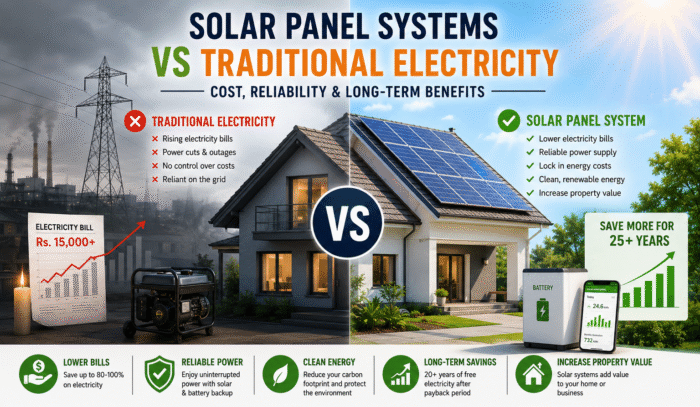
Sri Lanka’s electricity tariff structure is tiered, meaning the more you use, the more you pay per unit. A household consuming over 400 units per month can pay upwards of Rs. 60,000–70,000 annually — and that figure rises every time the Ceylon Electricity Board (CEB) revises rates. For businesses and industrial consumers, the burden is significantly heavier.
Solar power in Sri Lanka offers a practical, long-term solution. With abundant sunlight year-round — averaging 5 to 6 peak sun hours daily — Sri Lanka is one of the best-positioned countries in South Asia to benefit from rooftop solar installations.
Real-World Electricity Bill Savings: What Homeowners and Businesses Are Seeing
Residential Example — A Family Home in Colombo
A typical middle-income household in Colombo consuming around 500 units per month could expect a monthly electricity bill of approximately Rs. 15,000–20,000 under the current tariff. After installing an 8.5 kW on-grid solar system, that same household can generate roughly 969 kWh per month — enough to nearly eliminate the bill entirely.
Monthly savings: approximately Rs. 65,000+ per year Estimated payback period: 4–5 years Panel life: 25+ years
This means after recovering the initial investment, the system continues to generate free electricity for another two decades.
Small Business Example — A Retail Shop in Kandy
A small commercial outlet with refrigeration, air conditioning, and lighting — consuming 800–1,000 units per month — faces bills that can cripple operating margins. A 15–20 kW system can offset the majority of daytime consumption, dramatically reducing monthly overheads.
For businesses operating during daylight hours, the savings are even more pronounced since solar generation peaks exactly when consumption is highest.
Industrial Example — A Warehouse or Manufacturing Unit
Large industrial consumers who cannot fully offset their electricity bill through solar can still benefit significantly through the Net Plus scheme, where they earn LKR 37 per unit for every unit generated — regardless of their own consumption. A warehouse with a large unused roof area can effectively turn that idle space into a passive income stream.
How Solar Saves You Money: The Three Billing Schemes in Sri Lanka
Understanding which scheme applies to you is key to maximising your electricity bill savings.
Net Metering — Best for homes with high bills and limited roof space. The electricity you generate is subtracted from what you consume. If you generate more than you use in a month, the surplus rolls forward and reduces your next bill. With the right system size, you can bring your bill to zero.
Net Accounting — Best for homes with lower bills but more roof space. If your solar panels generate more than you consume, the CEB pays you LKR 37 per excess unit. This turns your roof into an income-generating asset on top of eliminating your bill.
Net Plus — Best for industrial consumers with large roof areas. You earn LKR 37 per unit for all electricity generated while continuing to pay your regular bill. Ideal for factories or warehouses where the roof generates significant power.
How Solar Power Works: A Step-by-Step Explanation
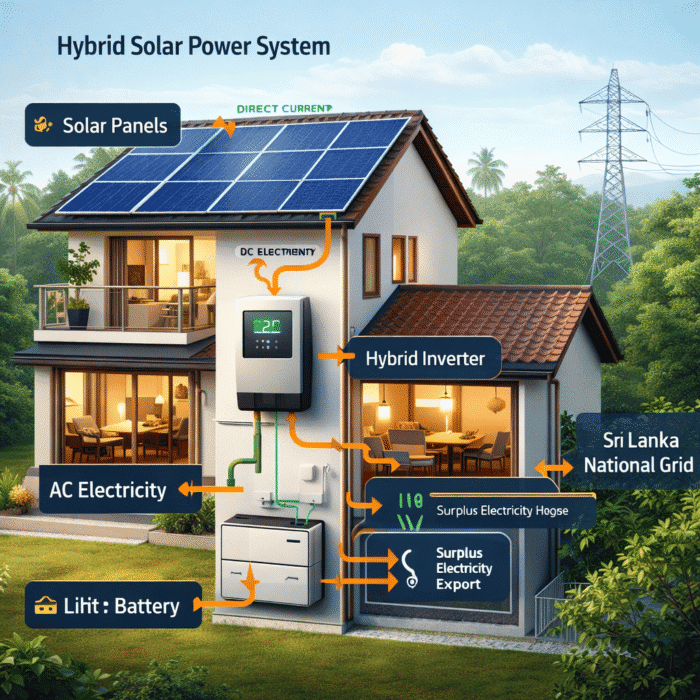
- Sunlight hits the solar panels on your roof during daylight hours.
- The panels convert sunlight into direct current (DC) electricity.
- The inverter converts DC electricity into alternating current (AC) — the type used by your appliances.
- AC electricity flows to your home, powering your equipment directly during the day.
- Surplus electricity flows through your meter to the national grid, earning you credits or payments.
- At night or during cloudy periods, you draw from the grid as normal — but your bill reflects the credits already earned.
- In a hybrid system, a battery stores surplus electricity for use after dark, reducing grid dependence further.
- You can monitor your system’s daily, monthly, and annual output in real time via a smartphone app or computer.
How to Get Started with Solar in Sri Lanka: A Step-by-Step Guide
Step 1: Assess your electricity bill. Pull out your last 3–6 months of CEB bills. Note your average monthly unit consumption. This is the starting point for sizing your system.
Step 2: Evaluate your roof. Determine how much usable roof area you have, ideally south-facing and unshaded. As a rough guide, an 8.5 kW system requires approximately 43 square metres of roof space.
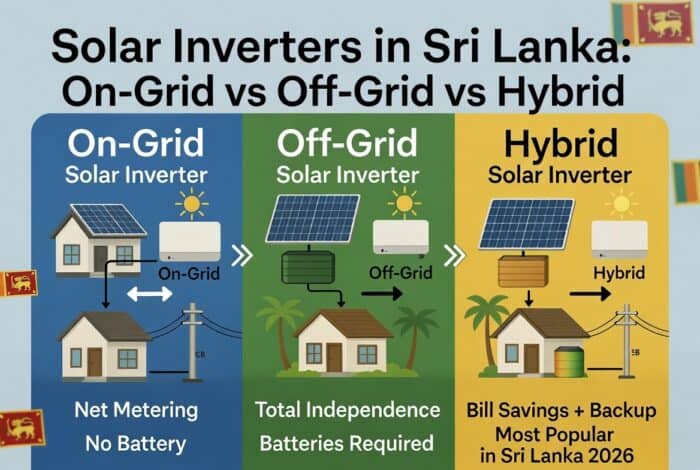
Step 3: Choose the right system type. Decide between an on-grid system (lower cost, connected to the CEB grid) or a hybrid system (includes battery backup, provides power during outages). Both are viable — your choice depends on your budget and how critical uninterrupted power supply is to you.
Step 4: Select a reputable installer. Look for a company with a proven track record, quality equipment, and after-sales support. St. Anthony’s Solar is one of the most established solar power in Sri Lanka providers, offering tailor-made solutions, panel warranties of up to 25 years, and a nationwide service network.
Step 5: Apply for CEB approval. Your installer handles the technical paperwork and meter upgrade required for net metering or net accounting schemes.
Step 6: Installation and commissioning. A professional installation typically takes 1–3 days for residential systems. Once commissioned, monitoring begins immediately.
Step 7: Track your savings. Use your inverter’s monitoring portal or app to watch your generation, consumption, and savings in real time.
What Equipment Determines the Quality of Your Savings?
The quality and efficiency of your system directly affect how much you save. Here’s what matters:
Solar Panels: High-efficiency panels generate more electricity from the same roof area. JA Solar’s 550W monocrystalline modules, used by St. Anthony’s Solar, operate at 20.9% efficiency — well above the market average of 16.4%. That efficiency gap translates directly into more units generated and more money saved per square metre of roof.
Inverters: The inverter converts DC to AC and is the brain of the system. Premium inverters like SMA (Germany) and Sungrow achieve up to 98.7% efficiency, meaning very little of your generated electricity is lost in conversion. Both brands offer 10-year warranties.
Hybrid Batteries: For those who want maximum independence from the grid, lithium iron phosphate batteries (such as the BYD HVS range or GSL batteries) store surplus daytime generation for nighttime use. These batteries support over 8,500 charge cycles and come with 10-year warranties — making them a long-life, low-maintenance asset.
Monitoring: Real-time monitoring via smartphone or computer lets you track daily and monthly generation, verify your system is performing optimally, and identify any issues early.
Frequently Asked Questions About Solar Power in Sri Lanka
How much can I save on my electricity bill with solar? It depends on your consumption and system size. A well-sized system can reduce your bill by 80–100%. Based on the St. Anthony’s Solar residential calculator, a household consuming around 1,000 kWh monthly can save approximately Rs. 65,000+ per year with an 8.5 kW system generating 969 kWh per month.
How long does it take to pay back the investment? The average payback period in Sri Lanka is around 4–5 years. After that, your electricity is essentially free for the remaining 20+ years of the system’s life.
Do solar panels work on cloudy days? Yes. Solar panels generate electricity even on overcast days, just at reduced output. Sri Lanka’s climate, even during the monsoon season, provides enough sunlight for meaningful generation year-round.
Can I use solar during a power cut? With a standard on-grid system, the inverter automatically shuts off during a grid failure for safety reasons. If you want power during cuts, you need a hybrid system with battery storage — the battery supplies power to your home when the grid goes down.
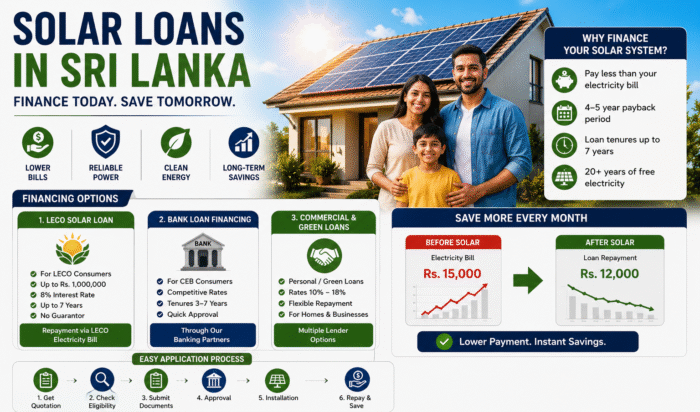
Is there a government incentive for solar in Sri Lanka? Yes. The CEB’s net metering, net accounting, and net plus schemes are government-backed programmes that allow you to offset or sell your surplus electricity, significantly improving the financial returns of your investment. Financing options are also available — see St. Anthony’s Solar’s financing page for details.
What maintenance does a solar system need? Solar systems require very little maintenance. Panels should be cleaned periodically (especially during dry seasons) and the inverter should be checked annually. St. Anthony’s Solar offers ongoing service support across the country.
How much roof space do I need? A typical 8.5 kW system requires around 43 square metres of usable, unshaded roof space. Smaller systems (3–5 kW) need proportionally less. Your installer will assess your roof during the site survey.
What happens if I generate more electricity than I use? Under net metering, excess units roll forward to offset your next bill. Under net accounting, the CEB pays you LKR 37 per excess unit generated.
Is solar power suitable for apartments? Standalone apartments with individual roof access can install solar. However, common roof spaces in apartment buildings require a collective agreement. Hybrid systems with smaller panel arrays are increasingly popular for apartments with limited roof access.
How do I choose a trustworthy solar company in Sri Lanka? Look for companies with a long operational history, clear warranty terms on both panels and inverters, verified installation references, and a national service network. If you’re ready to explore your options, you can contact St. Anthony’s Solar for a free consultation and custom quote.
Most Searched Topics About Solar Power in Sri Lanka
Solar panel prices in Sri Lanka 2025: Prices vary based on system size, panel brand, and inverter type. A 5 kW on-grid system typically starts in the range of Rs. 1.5–2 million, while an 8.5 kW system with premium components is priced higher. Contact your installer for a tailored quote.
CEB net metering approval process: The process involves submitting an application to the CEB, a technical inspection, meter replacement, and final approval. A registered installer handles all of this on your behalf.
Best solar companies in Sri Lanka: Look for companies with demonstrated expertise, quality equipment partnerships, and nationwide service capability. St. Anthony’s Solar, headquartered at No. 524, Sri Sangaraja Mawatha, Colombo 10, has been a trusted name in the industry for many years.
Solar system capacity for home use in Sri Lanka: For a home consuming 300–500 units per month, a 3–5 kW system is usually sufficient. For 600–1,000+ units monthly, an 8–12 kW system is more appropriate.
Hybrid vs on-grid solar Sri Lanka: On-grid systems are more affordable and suitable for homes with stable grid supply. Hybrid systems cost more due to battery storage but provide backup power during outages — a key consideration in areas with frequent load shedding.
Conclusion
The numbers are clear: switching to solar is one of the best financial decisions a Sri Lankan homeowner or business can make right now. With electricity tariffs continuing to rise, a solar system locks in your energy costs today and pays for itself within five years — leaving you with free power for the following two decades.
Whether you’re a family looking to cut household expenses, a small business trying to protect margins, or an industrial consumer with a large roof, there’s a solar solution that fits your situation. St. Anthony’s Solar offers tailor-made on-grid and hybrid systems backed by premium equipment, 25-year panel warranties, and a nationwide service network.
Ready to find out exactly how much you could save? Get in touch with St. Anthony’s Solar today for a free quote and site assessment.